Service Charges, Surcharges, Cash Discounts, and Dual Pricing: A Plain-English Guide
 Paul AdamsJul 30, 20235 min read

Last reviewed: November 2026. This is general information, not legal advice.
Every card you take costs you something. There are four common ways to decide who pays that cost, and the names get mixed up all the time, even by people who sell them. Here is what each one is, what the rules say in California, and what we recommend.
Dual pricing
You post two prices for everything: a cash price and a card price. Both show on the menu, the shelf tag or the price list, and both print on the receipt. The customer sees both before paying and picks.
Dual pricing works in California and under the card networks' rules because nothing is added at the register: the customer pays a price they already saw. Our Evident Zero program is dual pricing. You pay 0% on cards and one flat monthly fee.
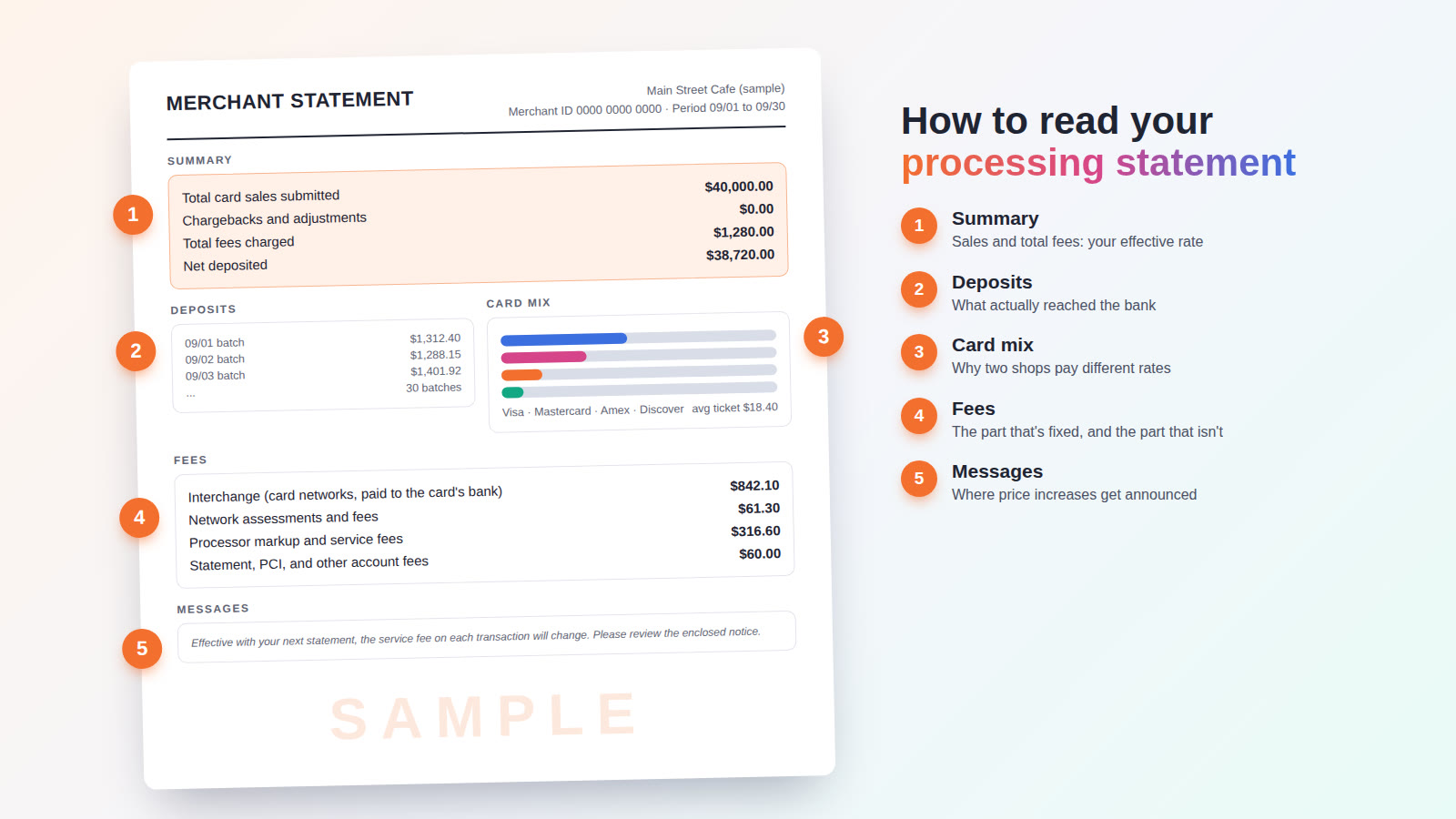
Send one statement. A person reads it and shows what you pay today and what you would pay on dual pricing, in writing.
Cash discount
You post one price, the card price, and take money off when a customer pays cash. California's Civil Code section 1748.1 allows a discount for paying without a credit card, as long as it is offered to everyone. Visa's rules allow it too, with one condition: the price you post has to be the card price. If the register starts from the cash price and adds something for a card, that is a surcharge, whatever the receipt calls it.
Federal law also lets you offer a discount for paying with cash, a check or a debit card, as long as it is offered to everyone and clearly disclosed. Our Evident Split program works that way: the card price applies to credit cards, and debit, prepaid and cash pay the lower price.
Surcharge
A surcharge is a fee added at checkout when a customer pays with a credit card. Visa and Mastercard allow it with conditions:
- Credit cards only. Debit and prepaid cards can never be surcharged, even when the customer presses "credit" on the terminal.
- No more than what the card costs you to accept, and never more than 3% on Visa or 4% on Mastercard.
- At least 30 days' notice to your processor before you start.
- A notice at the door and at the register, and the surcharge on every receipt as its own line.
California is where it gets unsettled. Civil Code 1748.1 says a retailer may not surcharge a customer for paying by credit card. In 2018 a federal appeals court ruled that the law violated the First Amendment as applied to the five businesses that sued, but it did not strike the law down for everyone, and it is still on the books. The state's Honest Pricing Law, SB 478, adds a second question. Our SB 1524 article walks through both.
That is why, in California, we recommend dual pricing over a surcharge. It gets you to the same place without the open legal questions, and it covers debit cards too.
Service charge
A service charge is a fee every customer pays, however they pay: an 18% charge on large parties, or a "kitchen appreciation" fee on every check. Because it does not depend on the card, card network rules do not cover it. State law does.
Under SB 478, a fee every customer has to pay belongs in the advertised price, with government taxes and shipping as the exceptions. Restaurants, bars, food concessions, grocery stores, grocery delivery services and caterers got a carve-out in SB 1524: they can list a service charge separately if it is shown clearly wherever prices are shown, with what it is for. Our SB 478 article explains the details.
The short version
| What you want to do | The short answer |
|---|---|
| Post a cash price and a card price (dual pricing) | Allowed. Show both before the sale. |
| Post the card price and take money off for cash (cash discount) | Allowed, as long as the posted price is the card price. |
| Add a fee at checkout for credit cards (surcharge) | Unsettled in California. The card networks allow it on credit only, capped and disclosed. |
| Add a fee for debit or prepaid cards | Not allowed by the card networks. |
| A restaurant service charge or large-party fee | Allowed if it is shown clearly wherever prices are shown, with what it is for (SB 1524). |
| Any other fee every customer pays | Put it in the advertised price. Taxes and shipping are the exceptions. |
See it on your own numbers
The fastest way to choose is to see what each option would cost on your own statement. Our savings calculator does the math in a minute, and a free rate review gives you the exact figure, line by line, from a person who reads statements all day.
Sources: California Civil Code section 1748.1; Italian Colors Restaurant v. Becerra (9th Cir. 2018); California Attorney General, SB 478 Hidden Fees FAQ; SB 1524 (2024); Visa's merchant surcharging Q&A; Mastercard's merchant surcharge rules; 15 U.S.C. 1693o-2 (discounts for cash, checks and debit).
Send one statement. A person reads it and shows what you pay today and what you would pay on dual pricing, in writing.